Friday, June 29, 2012

Ecology-drama and "it's complicated" written all over it

There are so many ways in which ecology becomes complicated.  The last example is a beautiful one-well studied, fairly well understood, and fairly simple.  The cichlid fish example works so beautifully because there happens to be only 2 major selection pressures driving coloration-sexual selection and water clarity.  But what if there was more to it?  What if suddenly a visual predator was introduced to both clear and murky systems?  Or what if there was increased fishing pressure?  More or less plant material?  Stark changes in diet?  Variables can add up very quickly and have enormous effects.

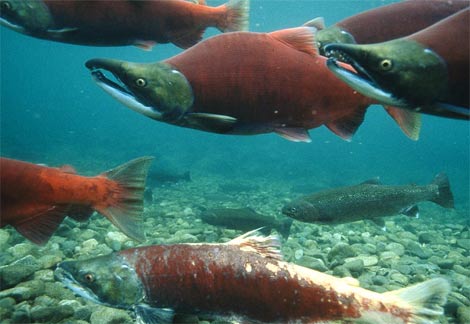
For example, salmon change to a beautiful bright red during breeding season in order to attract mates.  The bright the red, the more likely you are to pair up because you are PERCEIVED to be more fit.  Now a certain type of salmon called Kokanee got landlocked and now live in a lake system.  Most salmon derive their beautiful red color from their food, which contains a carotene for red coloration.  To adapt to their new environment, the Kokanee salmon improved their ability to obtain (sequester) red coloration from their food, which has much less carotene than the ocean available food of their counterparts.  Both Kokanee and "regular" salmon turn red during breeding season but if the regular salmon get into the lake system they are unable to turn red, because they cannot sequester such small amounts of carotene, and therefore are not chosen to breed, regardless of their actual fitness level.  A simple change in diet shifted mate choice based on coloration to a completely different and isolated level!  And of course, we have speciation as well much like the cichlids, which I do want to say is not necessary when these things occur.


Nothing gets this complicated variable idea across more than thinking about how to design an experiment.  For example, a study that aimed at looking at predation on small rodents by their larger, wolf and fox, predators took the home site of the rodents and fenced it off, denying access to the predatory mammals.  It is a tried and true method, good for animals or to protect plants or even insects from their known predators.  It didn't work here though, because the posts along the fence line attracted hawks and small falcons that wanted a perch, thereby increasing predation on the rodents via a predator that usually accounts for a very small amount of predation (if you're going to stop and rest why not grab a snack while you're at it?).  Oops.  So here even though we've removed the predator that based on observation and testing is the primary influence on the rodent life cycle, you see how moving one thing out of a niche (space/resource/habitat used by an animal in relations to others it shares said space with) how easy it is for something else to move into the open slot.
Your food always tastes better!


It is because species and their environments are so intermixed that these things happen.  There is no such thing as a food chain, only food webs.  One creature eating only one other species is the exception, not the rule.  Specializing can be good-if the source is available you become very efficient at handling and deriving nutrients from one thing.  However, the environment is shifty and even poor panda probably regrets it's monogamous relationship status with bamboo.  Moreover more than one thing will determine a species or individuals fitness-habitat, shade, food, water, nutrients, substrate, predation, etc.  Then, each of those factors is controlled by any number of additional factors, habitat for example-competition for space, degree of visibility required, predation, hunting, community of plants, nutrients, flooding, fires, access to mates, etc.  You can see how one thing rarely dictates the response of a given species.

To sum this up let's think about how this looks graphically.  You have your species and the response of said species (i.e. weight, survival, food choice, etc).  On the graph you get a huge cloud of points through which you draw a line, which represents your variable.  The line will likely trend the points with an r squared of maybe 0.1 or 0.2.  In other words, your variable can explain the response of the species about 10-20% of the time.  Seems low considering in chemistry you need above 80%.  But makes sense right?  It has to be one serious pressure to make up 80% of the life response of an individual!  Think about what controls your day to day activities?  Some things are certainly more important than others, but no one thing controls you.  Ecology sets out to find the more important things, from which we can glean the most information about that species in that environment.  Hence why the possibilities are endless!!

Stay tuned! Next week I'll talk about what I did my master's work in and how it puts a whole new twist on this complicated relationship!!


"When one admits that nothing is certain one must, I think, also admit that some things are much more nearly certain than others." Bertrand Russell

Thursday, June 21, 2012

Ecology: complicated and delicious, just like your ex's facebook status

Ecology was truly love at first sight.  Now I'm not normally one for complicated relationships, but something about ecology has always made my toes tingle. Ecology is the study of the relationship of species and their environment. Like all relationships, this one is dirty, convoluted, and complicated.  Like a good relationship though, I can also be very rewarding and exciting.  Upfront the idea of ecology may seem very simple. You take a species and see how it responds or affects its habitat.  And it's insanely relevant, answers to those questions can help inform conservation, forestry, zoos, climate change, habitat management, zoning, invasion, biological control, and so on.  You also end up incredibly well rounded, using mathematics theory, statistics, experimentation, laboratory control, cross departmental collaboration, biology, physics, chemistry, aquatics, animal behavior, and evolution. Okay, so now you can see how this can get so complicated.

My bio stats professor once said that ecology will always be a strong career because there's never any way to answer everything about even one question. Realistically, the possibilities are endless.  You could have 9 hypotheses to test and none of them be the correct theory.  Moreover, ecology is almost never controlled by one variable. Let's look at the situation that originally got me interested in ecology my junior year in college as a simple starting point.

I still have the original article, I never got rid of it.  It's a 1997 article in Science (one of the top 2 science journals in the world, likely only second to it's London counterpart, Nature).  "Cichlid Fish Diversity Threatened by Eutrophication That Curbs Sexual Selection."  Okay, let's look at this concept bit by bit.

  1. The species: Cichlid fish are found in many places in the world, although warm water.  They are well studied for their species divergence by population.  In other words, often when a population of cichlids becomes isolated in a lake or water way they specialized and diverge.  If they are reintroduced to the population they come from (the source) there will no longer be any breeding between the populations.  
  2. Eutrophication: In aquatics, the water quality and clarity is often generalized into 3 majors groups
    1. Oligotrophic: clear crystal water with little algal blooming or fertilizer
    2. Mesotrophic: moderate clarity with some algal blooms likely giving the water a hue of blue or green for parts of the year
    3. Eutrophic: murky, dark water with little clarity and high algal blooms giving the shoreline a very green color. SO when we say "eutrophication" we mean a lake that is moving (or being pushed) towards poor water clarity and quality.  In this case reducing vision within the water column. 
  3. Sexual selection: Alright so this term should be more familiar since we talked about it in my evolution post.  Specifically here it is important to know that females choose their male mates based on color and color brightness.  So there is selection pressure on the males to be a certain color and to be a very bright variant of that color.  Think about how this would be different if there were a predator? 
  4. So the kicker with this research is that over time, as the lake becomes more euthrophic and more murky, the females have less ability to visually choose their males and often do so indiscriminately.  They breed across the lines of sub species as well, no longer able to choose by color.  As a result, there is no benefit for the male to invest a lot of energy in being colorful so there is a reversal (another term you know!) to being dull fish.  The males and females were becoming dull grey in color and the populations were almost completely intermixed again as a result!!!

Alright, I will continue to talk about ecology next week and how it becomes more complicated.  If you have any questions so far, let me know!


"Science is one thing, wisdom is another. Science is an edged tool, with which men play like children, and cut their own fingers." Sir Arthur Eddington

Wednesday, June 13, 2012

Science-how the study itself adapts and evolves!

Science!  One of the things that is often misunderstood and misconstrued is scientific theories (and the process by which they are derived).  One of the major problems for this is scientists have established their own little world with its own lingo and set of standards.  The good thing?  These standards have a very good tenancy to hold up (as in relation to society-more on this in a bit).  The bad thing?  Nobody normal gets it.  Mercy sometimes I don't get it, so let's talk about some of the things that science does that incidentally fuels the anti-Darwin fires.
  1. THEORY: A theory as the average person thinks of it is a constructive thought process by which a philosophy or belief is based according to perceptions and observations.  Again, I cite the Annunaki (the reptile aliens from a previous post), which is a theory that aliens had intermixed with humans. The theory arose from ancient Sumerian text and carvings.  The beings have traits apparent in certain (select?) humans and the whole shebang.  The term is actually not even caught by spell check it is so common.  They even tie in the the UFO theories and the Builderberg Group/New World Order theories.  They all sound new, they're not mainstream, and honestly some of them are just plain crazy.  
  2. HYPOTHESIS V LAW: The problem is scientists don't use the word theory as we just described it.  The term "hypothesis" would tie up much more closely to this definition-a series of ideas or questions built on observational framework.  A scientific theory comes much further down the process line.  First you have a hypothesis, then you propose how to test it, you test it, get results, and draw conclusions based on your test and the subsequent set of results.  For any long standing scientifically accepted theory, that process needs to be performed many times by many different people (repeatable results). Very similar to scientific law.  In fact, the law of gravity is actually a theory according to scientific terminology, but I don't see very many people jumping off the building in order to fly home.   
  3. SOCIETY: Science, like every other construct is the black duck of society.  You follow what people want to hear or you get squished.  Example-Ptolemy was able to explain heavenly bodies in motion with an Earth at center basis, he used concentric circles so technically the pattern matched the data.  What was more important was that it matched societies view so it stuck around for 1600 years, even though Galileo figured out the real pattern much sooner than that.  But what happened to Galileo?  Oh, he died in prison...  Now Ptolemy did not screw with data and forcefully misconstrue anything, based on what he had to work with and his observations it fit the pattern fine.  The issue here is that poor Galileo got squashed when he had a DIFFERENT idea, and it took almost 200 years to make it mainstream.  Society also governs what's important, or what types of things scientists should focus on.  AIDS research didn't really go into full swing until the 1990's, but was discovered in the 1970s and named.  However, because of the stigma, it wasn't "important" for mainstream research so it was very difficult to get funding.  It's kinda like that city law that so many accidents need to happen in an intersection before they'll budget in a stoplight.
  4. WRONG: Like I just mentioned, sometimes science gets it wrong.  Sometimes it's completely innocent-trying to draw conclusions based on only a few pieces of evidence.  But you have to start somewhere in order to make progress.  Sometimes though, people do bad things, which I'm sure doesn't surprise anybody.  And let's face it, this isn't a construct isolated to the sciences, or even to our society.  However, the example I want to use I've actually seen brought up in a Darwin v God debate.  His name was Johann Meckel.  He made a very famous move in the early 1800s.  Meckel believed development of an embryo mirrored evolution (not that strange of an idea in the early 1800s).  He spent several years of his life studying it.  The issue was (of course) that it just isn't true, the development of an embryo does not mirror the procession of evolution through time.  Instead of admitting his failure, he was so passionate and emotionally tied to his idea that he forged drawings and had them published.  These drawings were even used in textbooks for a couple of years until someone figured out his masking attempt.  That's the perk about science, it has to be testable and repeatable by someone else.  Of course, the drawings have been stricken from teaching and his name only comes up to demonstrate a very bad point.  In fact it took me 10 minutes and 5 pages in google images to find his little faux pas (he went on to do some other quite spectacular things medically).  The point is that even though science makes mistakes, it is able to admit the issue and adapt to new information (even if it takes a while) which is certainly more than can be said of other passionately driven constructs.  No societal construct is perfect!  

Wednesday, June 6, 2012

Evolution: let's get this straight people!

Being in the science field I've seen some pretty interesting misunderstandings about the theory of evolution.  Some funny and some scrape your eyes out painful.  Although the first painful argument I often hear is about evolution being a "theory", that merely stems from people not understanding scientific processes and scientific theories as they differ from your drunk roommate insisting the entire human race is partially controlled by lizard space beings called the Annunaki (this is a real CONSPIRACY theory, check it out).  However, I will delve into that in a later post.

For now I think I will take you through the basics of evolution, in a way I teach all my little youngens in my vertebrate evolution course.  As with class, feel free to ask questions, I will post answers.

Natural Selection: fundamental mechanism (process) by which evolution occurs.  It is based on the struggle for existence and organisms' competition for space and resources.  This includes migration, mutation, genetic disease, and death.  Natural selection requires 3 basic constructs to occur:
  1. Variation: individuals within a population differ from each other in their traits (also referred to as phenotype or characteristics)
  2. Inheritance: aforementioned traits need to have a genetic basis.  AKA I can pass my awesomeness down on to my children.  (Please note, traits for this CANNOT be acquired-e.g. picked up by the parent through the course of life-it needs to be in the DNA code.  Therefore if you adhere a horn to a horse and have that horse breed, its foals will not be born or develop horns [again, real study way back in the day, check it out])
  3. Fitness: given competition and limited resources, not all individuals will have the maximum capacity to reproduce. The struggle for space, food, and survival will cause a gradient in success for mating and offspring.  Therefore, this inequality means individuals will contribute differently to the next generation (high fitness=higher contribution).
Sexual Selection: secondary mechanism that is based not on actual survival but on a potential mate's perception of your fitness.  E.g. red coloring in bird.  Being red does not make you a faster runner but indicates since you are very brightly colored and alive you're probably good at escaping predators.  This includes mate choice, coloration, size, combat, display, plumage, etc.  In some cases, sexual selection can actually work in the opposite direction of natural selection.  Certainly male peacock tail feathers do not benefit them for survival but the ladies think it's awfully sexy!


Constraint: evolutionary limits.  Evolution IS NOT progress towards a perfect organism.  Evolution is more like an engineer piecing together the best option out of some mismatched hunks.  Bear in mind that evolution (generally) occurs over a very long time, and many of the traits you see weren't developed to survive in THIS moment, they were developed THEN.  As their landscape, competition, and resources change they are constantly changing too.  But you don't get to wipe your slate clean every time, you have to use what you've got.  Pigs don't have wings, not because wings wouldn't be beneficial to a pig but because the pig's body design would certainly not support flight.

Teleology: explanations of a trait based on its PERCEIVED purpose rather than natural (mechanistic) origins.  Many non evolutionists fall into this trap, as have some scientists (everybody makes mistakes, it's what you do with them that matters, see later Science post for more on this).

Contingency: chance historic events.  These are things like catastrophes (lightning, eruptions, etc) or continental drift that may strongly impact the evolutionary path but is not based on fitness.  Sort of being in the wrong place at the wrong time kind of idea.


NOW, given the information above the way origins are traced and mapped is called PHYLOGENY.  Historically (aka before we started DNA sequencing everything) this was based on trait relationships, which in some cases were perceived since whether or not traits are similar because of function, common ancestry or common pressures is hard to tell.  You end up with two groups, or two and a half?
  1. Homology: traits are similar because they are of common origin
  2. Homoplasy: traits LOOK similar because two separate groups underwent similar natural selection pressures (like hopping mice in the African and American deserts-they're not related but they're traits are almost identical since there are only so many ways to deal with movement across sand!).
  3. Reversals: this isn't so much a third group as much as a related issue.  Sometimes traits REVERSE or switch back to a previous evolutionary state due to a shift in selection pressures.  As you can imagine, this can really mess up how we try to order things. 
Many of these issues are starting to get worked out with DNA sequencing, where you can see and follow exact mutations and deletions in the code and follow them through time.  

Misunderstood information:
  1. Missing link: there is no such thing and it wouldn't be necessary for there to be one.  Changes through evolutionary time are GRADUAL, you can tell because even today with our existing species there is an incredible amount of debate on what is a species and what is a subpopulation.  Certainly it is not any easier when you don't have the ancestor population with you as you make the comparison.  Not only is this process gradual, with small changes occurring and building up over time, but when it doesn't work the individual doesn't reproduce or they die quickly, such individuals are in low enough proportion that they don't contribute to the gene pool or the fossil record.
  2. Species that are ill adapted to their system: sure, again GRADUAL.  Evolution takes time so often there is a little bit of a time lag between successful evolutionary adaptation and the landscape they are adapting too.
  

Remember, the idea is that through shifting adaptive landscapes (changes in their resources, climate, habitat, competitors, etc) exert pressure on a species.  The most successful (fit) individuals pass on their genes to the next generation (passing on awesomeness) while the less fit individuals do not (kill off lameness).  Therefore the next generation is proportionally more fit than the previous one and the pathway continues.  Sometimes there is more than one "equally" fit answer to a given problem or part of the population migrates and is presented with a new set of pressures.  This is (in part) how speciation occurs.  The success of some species over others within the same line and against sister lines is how evolution occurs.

There, now you all survived half of day 1 in my class.


"The most exciting phrase to hear in science, the one that heralds new discoveries, is not 'Eureka!' (I found it!) but 'That's funny ...' " Isaac Asimov


Wednesday, May 30, 2012

Applying to graduate school-The real journey begins

Step 5. Before moving to your new school.  This is going to sound lame, but seriously spend a lot of time at home.  I don't mean that dumpy little apartment that your trainer friend throws parties in (wherein you vomit off the back balcony as you recall from the previous post...) but your home home.  Mom, dad, little brother or what have you.  This may be the last time you get a chance to be a child and live free.  Things get expensive and very self-sufficient from here on out and you don't get whole summers and winter breaks off anymore.  Enjoy the babying while it lasts, trust me.


Now, if you've been following the timeline, you will likely spend 5-6 months preparing and applying for grad school, 2-5 months sweating for results, over $300 in expenses directly related to said applications (of course this doesn't include the running naked in the street bail money), and $? in moving expenses.  Not a process for the weak.  Loads of benefits, but not an easy path in life to take.

Since at this stage, you are heading towards or have finished your undergrad, here's a nice little tip list to keep your head on straight.  Basically, stop panicking because it really ISN'T a big deal and don't go through life being an entitled douche-bag.  See how politicians and political analysts act on tv?  Don't be them.  Unless you are going into that field, in which case douche-it-up because that's the only field that really pays in...
http://jezebel.com/5910701/congrats-new-grads-by-the-way-you-dont-know-anything

Before you panic and jump off the academic bus (or cliff, depends on your level of drama) remember, if you're even considering applying to grad school you obviously have an incredible amount of love and interest for what you do.  Good things in life never come easy and remember my first post-there are still a lot of fun perks that come from the process, and of course that papery degree thingy at the end that allows you to lead and do what you want in your field.  That's pretty great to.

"Anyone who has never made a mistake has never tried anything new" Albert Einstein

Wednesday, May 23, 2012

Applying to graduate school-Crocodile tears


So you've got your app in, now what? WAITING, LOTS AND LOTS OF WAITING

Step 4. Getting your response letters.  No matter how awesome you are (or how awesome you think you are...) you are going to get rejection letters.  And you can act tough, they suck.  It never feels good when you've been busting your butt at school, going out less than your athletic training major friend, and taking more hours of work than your course credits realistically reflect and then have someone say sorry, you're not good enough and all the butt busting was a waste of time.  It's not true of course, that butt busting means a lot in any competitive situation and that's all this is.  Many factors go into choosing grad students, previous work, courses, networking, and "goodness of fit," or how well you seem to match up.  I know it seems ridiculous since all this is based on a couple of emails, a crappy application, and (if you're super lucky) a phone interview.  Take my advice, open your letters (or emails or phone calls) in your room.   If it's good news run into the streets naked screaming and crying with glee (this may also be an additional expense tacked on to getting into school if you get caught though mind you).  However, if it's bad news you can recenter yourself private and cry or punch a pillow or what have you without any pity faces staring you down.


"I'm extraordinarily patient, provided I get my own way in the end." Margaret Thatcher

Wednesday, May 16, 2012

Applying to graduate school-Applying to sell your soul


Now that we've gotten all the prep work out of the way, let's talk about what happens during the actual process.

Step 3. Actually applying to said graduate schools.  SchoolSSSS, meaning more than one.  Never put all your eggs in one basket.  On the upside, the applications usually all want the same thing.  General information, upload your UPDATED resume, and some essays.  The essays are basically all the same and are another step of prostituting out your skills.  It's always, explain how you would benefit from education at this institution blah blah.  Honestly, look at the essays first on these apps and write out responses in word files that you can copy and paste from later.  Use spell check.  And make sure that when you use the same essay for different schools you still personalize parts for each university within the essay.  AND BE CAREFUL TO CHANGE OUT SAID NAMES AND STATEMENTS FOR EACH!  You will be doomed if you make that faux pas.  The other major requirement is the letters of recommendation, usually from 3 professionals you know.  Again, do not ask your supervisor at Macy's.  Professors and teaching assistants (labs, small classes) that you had a particularly good relationship with make the best recommendations.  The same goes for any supervisors on relevant internships you have had.  Make sure 1) that you did well in their class (B or up) and 2) you had a good attitude while in class.  I have definitely had students ask for letters of recommendation that got C's or in my notes (yes, your teachers keep notes on your behavior if they know you or the class is below 30 students) it will say "leaves early" "snippy" "disinterested and refuses to discuss class information."


Don't ask!  I'm usually gentle, the few times I've said no I'll fib a little "I'm very overloaded with work right now and don't feel I could give you an accurate representation" or "I'm sure there are other classes with would be far more beneficial to your endeavor than mine."  Heads up though, others are not always so friendly so be very careful how you choose them.  Moreover, think about what field you're going into.  It helps if you have more letters from that or similar fields than your yoga instructor and meditation course.  The final kicker here is getting your transcript sent.  You need to send 1 (sometimes 2, though why any place needs 2 official board copies I don't know...) to each school.  Subsequently, when you are accepted you will need to send the final transcript (aka post-graduation showing your degree earned) as well.  These babies run about $8 a pop, not a big deal until for 4 schools you realize you need to send 7 transcripts.  Don't let it take you by surprise.

"It is the mark of an educated mind to be able to entertain a thought without accepting it." Aristotle