Showing posts with label ecology. Show all posts

Thursday, August 2, 2012

Speciation: What the and the why hows??

Speciation (process of species forming) seems simple enough on the surface.  Over time adaptation and evolution drive a divergence between two populations.  Let's take a population of birds.  The population splits as it colonizes around a large mountain range.  As each subset of the original population colonizes farther and farther around the mountain range, each subset is undergoing natural and sexual selection pressures.  Of course, these pressures are not the same on both sides of the mountain, you have different light, weather, environment, predators, nesting sites, etc. When the two subsets reach the other end of the mountain range and re-converge they no longer recognize each other as of the same species.  They choose different nest sites and even sing slightly different songs.  They are both different from each other and from the original source population.  This particular mechanism is referred to as "ring species."  The image below shows why.

As a side, when looking for an image to help show this I found a lot of creationism websites that use ring species and speciation as reason to show evolution does not exist.  They cite that such species are not stead fast and singular and thereby are not showing evolutionary process.  To this I say, by being fluctuating and changing they certainly aren't showing that they were put on this Earth in their perfect form then are they?  Ecology and evolution are messy, that's why they're so interesting.  If anyone actually knew the straight answer to everything, they'd get paid a lot more.

Now that aside, that issue of fluctuating species is the major point I actually want to talk about.  Apparently unbeknownst to our extreme creationist friends, it is not necessarily speciation that does the fluctuating, it is the way in which we define it.  Our example above shows speciation, up to three species total in the end.  The problem arises when we try to draw lines.  What about all of the colonies in the middle?  They're a little bit of everybody and would probably breed with more than one group.  What are they?  Hybrids may be the answer.  Mixes between two populations.  But that leads to all sorts of problems.  Let's take a step back first and look at why defining species is so hard in the first place.  Don't worry, we'll get back to this later.

Two guys named Coyne and Orr took time in their 2004 book on Speciation to figure out just how many different ways we had to identify species. Nine. Nine MAJOR ways with sub groups among them.  These range from change of habitat, to reproductive isolation, to genetic change, to biochemical effects and so on.  Now firstly I'd like to dispel the "genetics is the answer to all" idea.  I more than understand and respect using genetic code changes, especially since genetics of course is one of the necessary basic constructs for evolution to occur.  But bear with me and follow me through an example.

When I took my Phycology course (study of algae) I was confronted with a interesting and (at the time) frustrating situation.  We were in lab learning to identify different species of algae.  I was identifying one using the standard dichotomous key.  For those of you who are unfamiliar, a dichotomous key takes characteristics for a given specimen and splits them into 2 groups-Spines are present or absent.  You follow the pathway for your given sample and if you play your cards right you use these split characteristics to arrive at the proper identification.  See below for a very general example.


Now, when I had reached the end of the road I had two choices that led to two related but separate species.  The way to tell the difference was by color.  More specifically, I had to decide whether my specimen was "dark lime green" or "apple green".  Ooookay, so I was stumped, thinking what is the actual difference between these colors (since my 64 crayons box was at home) and was it distinct enough for the average person to get right, even with the correct illumination.  So I brought my professor, here on the Triggerfish, over and explained.  Hand on my heart, the conversation went thusly.  Triggerfish quickly told me the answer.  I was surprised and asked how it could tell.  Triggerfish responded that it just knew.  I asked if the coloration was useful, it replied no, there was almost no way to make a correct assessment based on that.  (Okay, so for you following along by in large these two species look the same).  When I asked how it knew, Triggerfish replied that it knew the genetic coding for the species in the area (Okay so the genes were different).  I then asked in the two species had any ecological differences, looking for habitat choice, temperature tolerance, nutrient requirements.  The answer? No. Bluntly.  (So functionally these species were identical).  Then angry Triggerfish walked away.  I promise you will hear about Triggerfish again, it was a particular thorn in my side and the side of my other grad student counterparts.  Facebook page dedication and all (of course not under Triggerfish, combined with a terminator spoof if I recall).  I'll discuss this in my teaching posts as well, "I just know" and "try harder" are things you never tell a student.


Anyway, I digress, my point is these two algae were separated into different species groups because they were genetically distinct somewhere in their lines of code.  This to this day seems completely pointless to me, different shades of green and a little obscene if you will.  Moreover it shows that what seems to be the most straightforward way of assigning species isn't any more irrefutable than some of the others.  There's always a dance of where to draw the line, and people will argue violently on where to draw the line.

Next time we'll hit on other popular ways to define species and where those have pitfalls as well.

Don't forget, questions or comments are welcome!


"In science the credit goes to the man who convinces the world, not the man to whom the idea first occurs."
Sir Francis Darwin

Thursday, July 26, 2012

Paleoecology: A long-term complicated relationship. I can't break-up, my CD's are in his truck

Sorry about the delay, I was on a bit of vacation. Not thinking about school or work in real life and the internet universe as well. I'll make it up to you though!

Now, continuing on my previous train of though.  There are many ways in which ecology gets complicated and tends not to look as pretty as the previous post shows.

Let's look at some of my MS (Master's of Science) work as a starting point.

I worked in a field called paleoecology in order to tie in aquatic species with water quality to look at pollution affects on a lake over time.  Diatoms (see Fig. 1) are a form of algae that is made up primarily of silica, and therefore fossilizes in the sediment of the lake they live in when they die. What we can do then is take a core of the lake bed. Each year a new layer of sediment is added to the bottom of a lake. We can take a core of a lake, date it using chemistry (such as Lead 210 dating) and compare what things are in each layer of the core with the associated date.  This allows us to track ecological community changes (the relative number of each species or population of diatoms in a year) through time.  NOW in addition to all that knowledge you can also run chemistry on the surface of the lake bottom (before the chemicals mix or breakdown).  You can compare the water chemistry (things like nitrogen, phosphorus, oxygen, pH, or temperature) with the species found and their relative numbers. This can tell you the preference and tolerance of these species to a given water chemistry factor. So species that have a lot of individuals fossilized at the same level as the water chemistry you tested do very well in those conditions (say high nitrogen, which remember is basically a fertilizer).  Species that are low in numbers (or not in the sample) do poorly under those conditions.  With me so far?
Fig. 1: Diatoms
Fig. 2: A core from the bottom of a lake (depth of mud at bottom)

Okay then so here's the kicker, with the relationship of species to water chemistry, you can look back at older layers of the lake sediment and count the number of species and individuals that are fossilized.  Once you know the community structure, you can use that information to estimate what the water chemistry was likely like!  You can start to understand how a lake has change over hundreds or even thousands of years!!

Now of course, is where is starts to get dirty.  Remember this is still ecology.  So what happened with me is, after 2 years (normal length of a MS program), it didn't work.  But in a way that's what made the project really interesting (and of course at the time very frustrating).  When I ran my estimates and compared them to known emission rates of nitrogen from the area they were exactly inverted! My model checked out well against expected ecological relationships (we call it r squared, or how tightly the relationship of your data is). For something more linear like chemistry or physics you would never accept and r squared value below 0.8 or so (on a scale of 0-1).  In ecology? Remember 0.4 is fantastic and numbers like 0.1 are not even unusual.  The reason is that there are many factors that effect an organism and its habitat and the variable you are testing is likely only one piece of a much larger puzzle.  That doesn't mean it's not important, it just means it's complicated and intertwined.

In my case what we think may be happening is one particular species tends to completely dominate the older sediments, and the problem it this species is a known generalist (often can do well in many different conditions and it quite good at competing with other species for a limited resource).  I proposed that the model needed to be able to ignore such species.  More in depth later.  As a result I have a very controversial paper in lieu since the model has been used for 30 years.  So it's been hard to publish.  See previous Science post for likely reasons why...


"Science is facts; just as houses are made of stones, so is science made of facts; but a pile of stones is not a house and a collection of facts is not necessarily science."  Henri Poincare

Friday, June 29, 2012

Ecology-drama and "it's complicated" written all over it

There are so many ways in which ecology becomes complicated.  The last example is a beautiful one-well studied, fairly well understood, and fairly simple.  The cichlid fish example works so beautifully because there happens to be only 2 major selection pressures driving coloration-sexual selection and water clarity.  But what if there was more to it?  What if suddenly a visual predator was introduced to both clear and murky systems?  Or what if there was increased fishing pressure?  More or less plant material?  Stark changes in diet?  Variables can add up very quickly and have enormous effects.

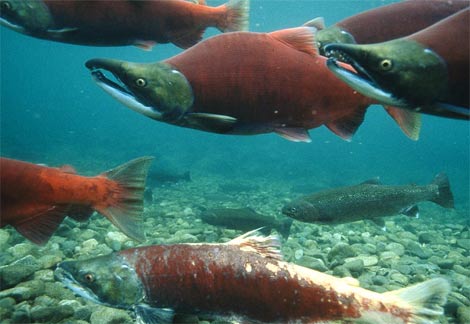
For example, salmon change to a beautiful bright red during breeding season in order to attract mates.  The bright the red, the more likely you are to pair up because you are PERCEIVED to be more fit.  Now a certain type of salmon called Kokanee got landlocked and now live in a lake system.  Most salmon derive their beautiful red color from their food, which contains a carotene for red coloration.  To adapt to their new environment, the Kokanee salmon improved their ability to obtain (sequester) red coloration from their food, which has much less carotene than the ocean available food of their counterparts.  Both Kokanee and "regular" salmon turn red during breeding season but if the regular salmon get into the lake system they are unable to turn red, because they cannot sequester such small amounts of carotene, and therefore are not chosen to breed, regardless of their actual fitness level.  A simple change in diet shifted mate choice based on coloration to a completely different and isolated level!  And of course, we have speciation as well much like the cichlids, which I do want to say is not necessary when these things occur.


Nothing gets this complicated variable idea across more than thinking about how to design an experiment.  For example, a study that aimed at looking at predation on small rodents by their larger, wolf and fox, predators took the home site of the rodents and fenced it off, denying access to the predatory mammals.  It is a tried and true method, good for animals or to protect plants or even insects from their known predators.  It didn't work here though, because the posts along the fence line attracted hawks and small falcons that wanted a perch, thereby increasing predation on the rodents via a predator that usually accounts for a very small amount of predation (if you're going to stop and rest why not grab a snack while you're at it?).  Oops.  So here even though we've removed the predator that based on observation and testing is the primary influence on the rodent life cycle, you see how moving one thing out of a niche (space/resource/habitat used by an animal in relations to others it shares said space with) how easy it is for something else to move into the open slot.
Your food always tastes better!


It is because species and their environments are so intermixed that these things happen.  There is no such thing as a food chain, only food webs.  One creature eating only one other species is the exception, not the rule.  Specializing can be good-if the source is available you become very efficient at handling and deriving nutrients from one thing.  However, the environment is shifty and even poor panda probably regrets it's monogamous relationship status with bamboo.  Moreover more than one thing will determine a species or individuals fitness-habitat, shade, food, water, nutrients, substrate, predation, etc.  Then, each of those factors is controlled by any number of additional factors, habitat for example-competition for space, degree of visibility required, predation, hunting, community of plants, nutrients, flooding, fires, access to mates, etc.  You can see how one thing rarely dictates the response of a given species.

To sum this up let's think about how this looks graphically.  You have your species and the response of said species (i.e. weight, survival, food choice, etc).  On the graph you get a huge cloud of points through which you draw a line, which represents your variable.  The line will likely trend the points with an r squared of maybe 0.1 or 0.2.  In other words, your variable can explain the response of the species about 10-20% of the time.  Seems low considering in chemistry you need above 80%.  But makes sense right?  It has to be one serious pressure to make up 80% of the life response of an individual!  Think about what controls your day to day activities?  Some things are certainly more important than others, but no one thing controls you.  Ecology sets out to find the more important things, from which we can glean the most information about that species in that environment.  Hence why the possibilities are endless!!

Stay tuned! Next week I'll talk about what I did my master's work in and how it puts a whole new twist on this complicated relationship!!


"When one admits that nothing is certain one must, I think, also admit that some things are much more nearly certain than others." Bertrand Russell

Thursday, June 21, 2012

Ecology: complicated and delicious, just like your ex's facebook status

Ecology was truly love at first sight.  Now I'm not normally one for complicated relationships, but something about ecology has always made my toes tingle. Ecology is the study of the relationship of species and their environment. Like all relationships, this one is dirty, convoluted, and complicated.  Like a good relationship though, I can also be very rewarding and exciting.  Upfront the idea of ecology may seem very simple. You take a species and see how it responds or affects its habitat.  And it's insanely relevant, answers to those questions can help inform conservation, forestry, zoos, climate change, habitat management, zoning, invasion, biological control, and so on.  You also end up incredibly well rounded, using mathematics theory, statistics, experimentation, laboratory control, cross departmental collaboration, biology, physics, chemistry, aquatics, animal behavior, and evolution. Okay, so now you can see how this can get so complicated.

My bio stats professor once said that ecology will always be a strong career because there's never any way to answer everything about even one question. Realistically, the possibilities are endless.  You could have 9 hypotheses to test and none of them be the correct theory.  Moreover, ecology is almost never controlled by one variable. Let's look at the situation that originally got me interested in ecology my junior year in college as a simple starting point.

I still have the original article, I never got rid of it.  It's a 1997 article in Science (one of the top 2 science journals in the world, likely only second to it's London counterpart, Nature).  "Cichlid Fish Diversity Threatened by Eutrophication That Curbs Sexual Selection."  Okay, let's look at this concept bit by bit.

  1. The species: Cichlid fish are found in many places in the world, although warm water.  They are well studied for their species divergence by population.  In other words, often when a population of cichlids becomes isolated in a lake or water way they specialized and diverge.  If they are reintroduced to the population they come from (the source) there will no longer be any breeding between the populations.  
  2. Eutrophication: In aquatics, the water quality and clarity is often generalized into 3 majors groups
    1. Oligotrophic: clear crystal water with little algal blooming or fertilizer
    2. Mesotrophic: moderate clarity with some algal blooms likely giving the water a hue of blue or green for parts of the year
    3. Eutrophic: murky, dark water with little clarity and high algal blooms giving the shoreline a very green color. SO when we say "eutrophication" we mean a lake that is moving (or being pushed) towards poor water clarity and quality.  In this case reducing vision within the water column. 
  3. Sexual selection: Alright so this term should be more familiar since we talked about it in my evolution post.  Specifically here it is important to know that females choose their male mates based on color and color brightness.  So there is selection pressure on the males to be a certain color and to be a very bright variant of that color.  Think about how this would be different if there were a predator? 
  4. So the kicker with this research is that over time, as the lake becomes more euthrophic and more murky, the females have less ability to visually choose their males and often do so indiscriminately.  They breed across the lines of sub species as well, no longer able to choose by color.  As a result, there is no benefit for the male to invest a lot of energy in being colorful so there is a reversal (another term you know!) to being dull fish.  The males and females were becoming dull grey in color and the populations were almost completely intermixed again as a result!!!

Alright, I will continue to talk about ecology next week and how it becomes more complicated.  If you have any questions so far, let me know!


"Science is one thing, wisdom is another. Science is an edged tool, with which men play like children, and cut their own fingers." Sir Arthur Eddington